M 103 Deep sky · Open cluster in Cassiopeia · M 103 · NGC 581
M 103
A small open cluster near Ruchbah in Cassiopeia — the last object in the catalogue as Messier published it.
Save the chart (SVG) Tactile chart (A4 SVG)
- Type
- Open cluster
- Designations
- M 103 · NGC 581
- Constellation
- Cassiopeia
- Apparent magnitude
- 7.4
- Apparent size
- 6′
- Position (J2000)
- RA 01h 33m · Dec +60° 39′
The full Moon, about 31′ across, is 5.2 times as wide. The Sun comes no nearer to it than 46°, around early May, so it is never lost in the Sun’s glare, which reaches about 15° out.
When to see it
On the night of Tue 12 Oct 2027, when it is highest around midnight, on each city’s own clock:
| From | Rises | Highest | Sets |
|---|---|---|---|
| London GMT+1 | Never sets | 01:10 · 81° | — |
| New York EDT | Never sets | 01:05 · 70° | — |
| Singapore GMT+8 | 19:07 | 01:15 · 31° | 07:24 |
| Sydney GMT+11 | Never rises | ||
Common questions
- Can I see it from 50° north?
- Yes, on any clear night of the year. From there it never sets: it is circumpolar, circling the pole and still 21° up at its lowest.
- Can I see it from 35° south?
- No. From there it never rises: you would have to travel north of 29° south before it cleared the horizon at all.
- When is the best time of year to see it?
- Around mid October, when it stands opposite the Sun and is highest at midnight. It comes round about two hours earlier each month, so by mid January it is highest in the early evening, and in mid July not until the hours before dawn.
- Naked eye, binoculars or telescope?
- Binoculars. At magnitude 7.4 it is past the eye, but a 50 mm pair under a dark sky reaches about magnitude 11.0.
Look for
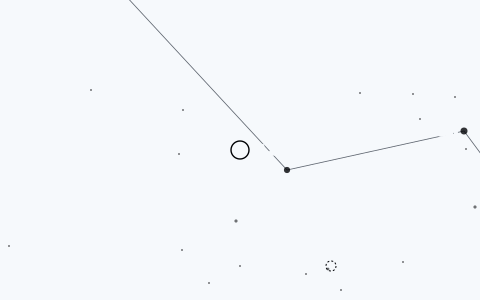
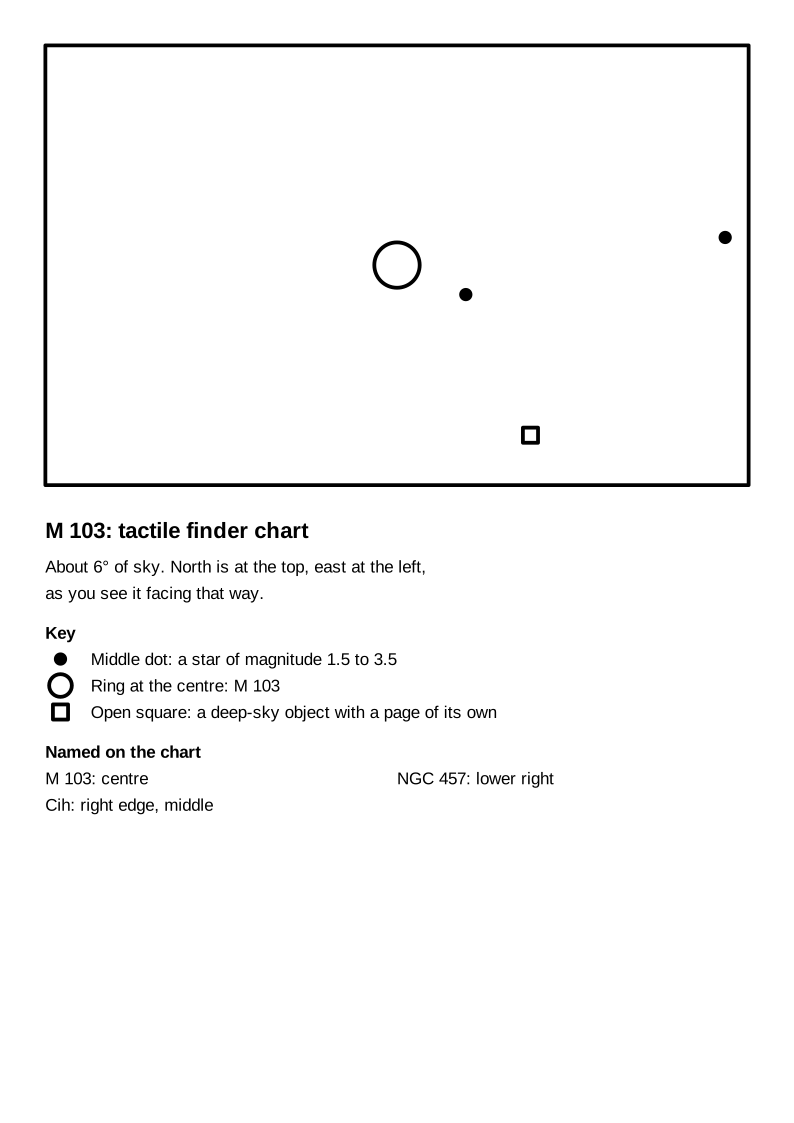
Find Ruchbah in the W and look just to its north-east. Binoculars show a little arrowhead of stars.
History
Pierre Méchain found it; later astronomers added more objects that Messier and Méchain had seen, but never published, to the end of the list.
Look for
From 50° north and 35° north it is circumpolar and never sets; from the equator it climbs to 29°; from 35° south it never rises.
Look for
Magnitude 7.4 against the faintest star each can show: the eye under a city sky, 4.5 (2.9 short); the eye under a dark country sky, 7.0 (0.4 short); 50 mm binoculars under that dark sky, 11.0 (3.6 to spare); a 100 mm telescope there, 12.5 (5.1 to spare). Through 7×50 binoculars, whose field is about 7.1° across, it spans 1% of the field’s width; through a 100 mm telescope at 50×, a field about 1° across, it spans 10% of the field’s width.