M 110 Deep sky · Galaxy in Andromeda · M 110 · NGC 205
M 110
The Andromeda Galaxy’s larger elliptical companion — the last object ever added to the Messier list.
Save the chart (SVG) Tactile chart (A4 SVG)
- Type
- Galaxy
- Designations
- M 110 · NGC 205
- Constellation
- Andromeda
- Apparent magnitude
- 8.1
- Apparent size
- 22′ × 11′
- Position (J2000)
- RA 00h 40m · Dec +41° 41′
The full Moon, about 31′ across, is 1.4 times as wide. The Sun comes no nearer to it than 34°, around mid April, so it is never lost in the Sun’s glare, which reaches about 15° out.
When to see it
On the night of Tue 28 Sep 2027, when it is highest around midnight, on each city’s own clock:
| From | Rises | Highest | Sets |
|---|---|---|---|
| London GMT+1 | Never sets | 01:12 · 80° | — |
| New York EDT | 15:46 | 01:06 · 89° | 10:26 |
| Singapore GMT+8 | 19:13 | 01:17 · 50° | 07:21 |
| Sydney GMT+10 | 20:36 | 00:08 · 14° | 03:40 |
Common questions
- Can I see it from 50° north?
- Yes, on any clear night of the year — it is circumpolar from there and never quite sets, though at its lowest it skims the horizon, where trees and haze will hide it.
- Can I see it from 35° south?
- Yes. It rises and sets, and at its highest it stands 13° up in the north.
- When is the best time of year to see it?
- Around late September, when it stands opposite the Sun and is highest at midnight. It comes round about two hours earlier each month, so by late December it is highest in the early evening, and in late June not until the hours before dawn.
- How bright is it?
- Magnitude 8.1 in total, but that light is spread over 22′ × 11′ of sky: on average 22.7 magnitudes per square arcsecond. Against a dark country sky that average stands out; a city’s glow drowns all but its brightest parts.
- Naked eye, binoculars or telescope?
- Binoculars. At magnitude 8.1 it is past the eye, but a 50 mm pair under a dark sky reaches about magnitude 11.0.
Look for
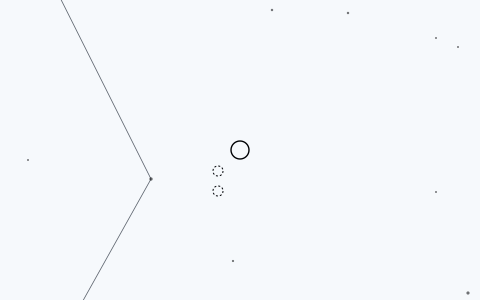
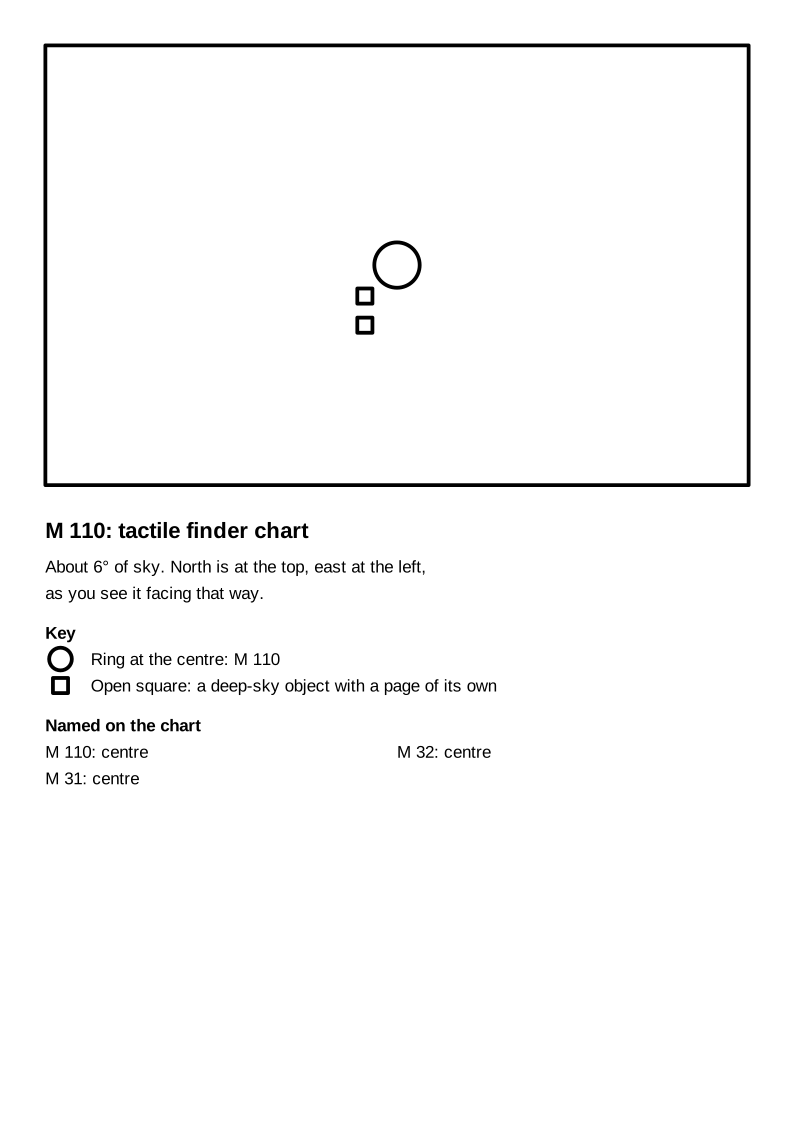
A low-power telescope on the Andromeda Galaxy shows it to the north-west of the core, as a faint oval, while M 32 sits on the other side.
Science
Unusually for an elliptical, it has patches of dust and young blue stars near its centre.
Look for
From 50° north it is circumpolar and never sets; from 35° north it climbs to 83°; from the equator it climbs to 48°; from 35° south it climbs to 13°.
Look for
Magnitude 8.1 against the faintest star each can show: the eye under a city sky, 4.5 (3.6 short); the eye under a dark country sky, 7.0 (1.1 short); 50 mm binoculars under that dark sky, 11.0 (3.0 to spare); a 100 mm telescope there, 12.5 (4.5 to spare). Those limits are for a point of light; its light is spread over its whole size, so it needs some of that margin in hand. Through 7×50 binoculars, whose field is about 7.1° across, it spans 5% of the field’s width; through a 100 mm telescope at 50×, a field about 1° across, it spans 37% of the field’s width.