M 40 Deep sky · Double star in Ursa Major · M 40
Winnecke 4
Messier’s one mistake: two faint stars he logged in 1764 while hunting for a nebula another astronomer had reported here. He found none, and wrote the pair down anyway.
Save the chart (SVG) Tactile chart (A4 SVG)
- Type
- Double star
- Designations
- M 40
- Constellation
- Ursa Major
- Apparent magnitude
- 8.0
- Position (J2000)
- RA 12h 22m · Dec +58° 05′
The Sun comes no nearer to it than 53°, around late August, so it is never lost in the Sun’s glare, which reaches about 15° out.
When to see it
On the night of Thu 25 Mar 2027, when it is highest around midnight, on each city’s own clock:
| From | Rises | Highest | Sets |
|---|---|---|---|
| London GMT | Never sets | 00:11 · 84° | — |
| New York EDT | Never sets | 01:05 · 73° | — |
| Singapore GMT+8 | 19:08 | 01:16 · 33° | 07:24 |
| Sydney GMT+11 | Never rises | ||
Common questions
- Can I see it from 50° north?
- Yes, on any clear night of the year. From there it never sets: it is circumpolar, circling the pole and still 18° up at its lowest.
- Can I see it from 35° south?
- No. From there it never rises: you would have to travel north of 31° south before it cleared the horizon at all.
- When is the best time of year to see it?
- Around late March, when it stands opposite the Sun and is highest at midnight. It comes round about two hours earlier each month, so by late June it is highest in the early evening, and in late December not until the hours before dawn.
- Naked eye, binoculars or telescope?
- Binoculars. At magnitude 8.0 it is past the eye, but a 50 mm pair under a dark sky reaches about magnitude 11.0.
Look for
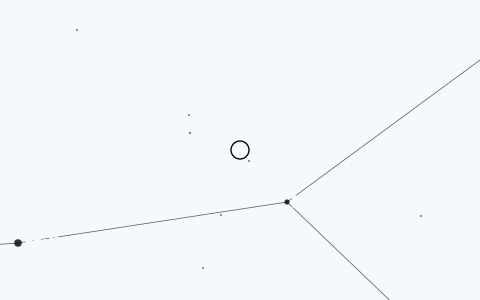
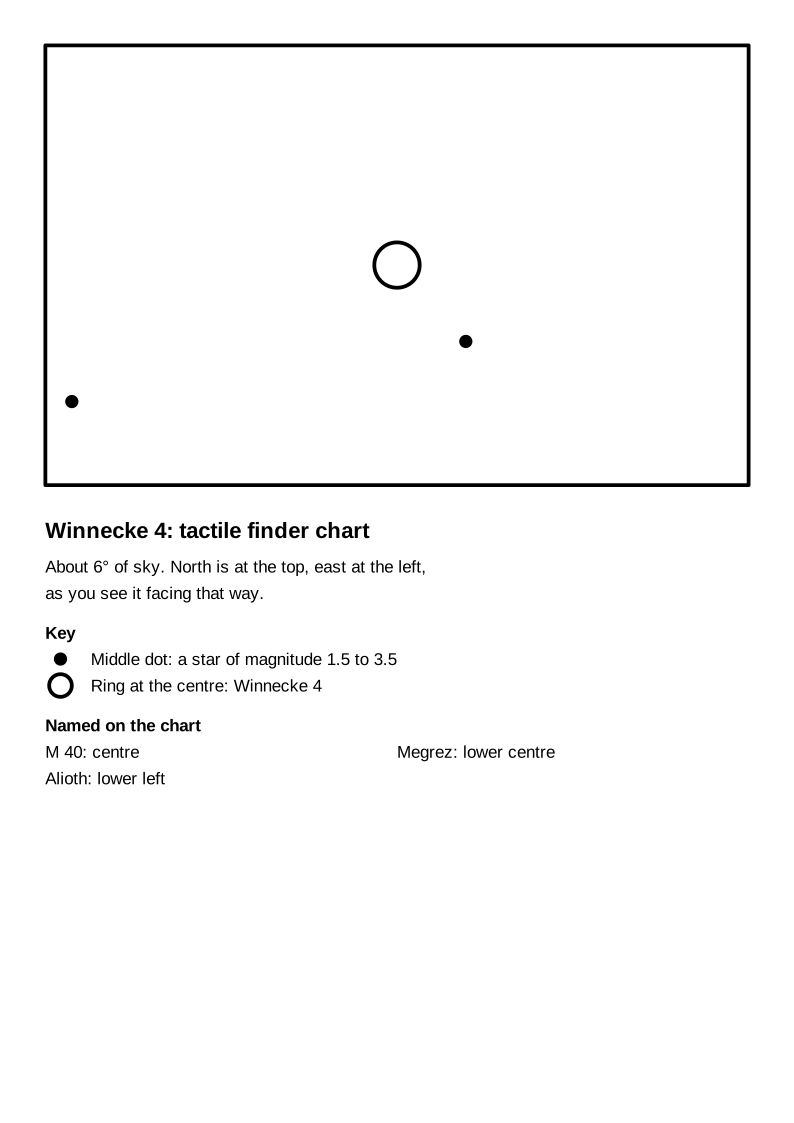
It lies just north-east of Megrez, where the Big Dipper’s handle meets its bowl. A small telescope splits it into two unequal stars, close together.
History
Friedrich Winnecke listed it as a double star in 1863, which is why it is also called Winnecke 4. Gaia has since measured both stars: they lie at very different distances, a chance line-up rather than a pair.
Look for
From 50° north and 35° north it is circumpolar and never sets; from the equator it climbs to 32°; from 35° south it never rises.
Look for
Magnitude 8.0 against the faintest star each can show: the eye under a city sky, 4.5 (3.5 short); the eye under a dark country sky, 7.0 (1.0 short); 50 mm binoculars under that dark sky, 11.0 (3.0 to spare); a 100 mm telescope there, 12.5 (4.5 to spare).