M 41 Deep sky · Open cluster in Canis Major · M 41 · NGC 2287
Little Beehive Cluster
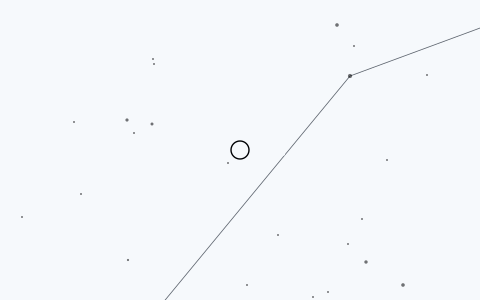
A bright open cluster just south of Sirius — visible to the naked eye, and perhaps the faint spot Aristotle described in antiquity.
Save the chart (SVG) Tactile chart (A4 SVG)

- Type
- Open cluster
- Designations
- M 41 · NGC 2287
- Constellation
- Canis Major
- Apparent magnitude
- 4.5
- Apparent size
- 39′
- Position (J2000)
- RA 06h 46m · Dec −20° 45′
At its longest it spans 1.3 full Moons laid side by side, the Moon being about 31′ across. The Sun comes no nearer to it than 44°, around early July, so it is never lost in the Sun’s glare, which reaches about 15° out.
When to see it
On the night of Wed 30 Dec 2026, when it is highest around midnight, on each city’s own clock:
| From | Rises | Highest | Sets |
|---|---|---|---|
| London GMT | 20:04 | 00:09 · 18° | 04:15 |
| New York EST | 19:21 | 00:04 · 29° | 04:47 |
| Singapore GMT+8 | 19:18 | 01:15 · 68° | 07:12 |
| Sydney GMT+11 | 18:08 | 01:06 · 77° | 08:04 |
Common questions
- Can I see it from 50° north?
- Yes. It rises and sets, and at its highest it stands 19° up in the south.
- Can I see it from 35° south?
- Yes. It rises and sets, and at its highest it stands 76° up in the north.
- When is the best time of year to see it?
- Around late December, when it stands opposite the Sun and is highest at midnight. It comes round about two hours earlier each month, so by late March it is highest in the early evening, and in late September not until the hours before dawn.
- Naked eye, binoculars or telescope?
- The naked eye, even from a city: at magnitude 4.5 it is brighter than the faintest stars a city sky still shows, about magnitude 4.5.
Look for
Drop south from Sirius by about a binocular field. It shows as a hazy patch to the eye, and as a swarm of stars with a red one near the middle in binoculars.
Look for
From 50° north it climbs to 19°; from 35° north it climbs to 34°; from the equator it climbs to 69°; from 35° south it climbs to 76°.
Look for
Magnitude 4.5 against the faintest star each can show: the eye under a city sky, 4.5 (right at the limit); the eye under a dark country sky, 7.0 (2.5 to spare); 50 mm binoculars under that dark sky, 11.0 (6.5 to spare); a 100 mm telescope there, 12.5 (8.0 to spare). Through 7×50 binoculars, whose field is about 7.1° across, it spans 9% of the field’s width; through a 100 mm telescope at 50×, a field about 1° across, it spans 65% of the field’s width.