M 67 Deep sky · Open cluster in Cancer · M 67 · NGC 2682
Golden-Eye Cluster
One of the oldest open clusters known — its stars are about as old as the Sun and made of much the same stuff, which makes it a laboratory for our own star.
Save the chart (SVG) Tactile chart (A4 SVG)
- Type
- Open cluster
- Designations
- M 67 · NGC 2682
- Constellation
- Cancer
- Apparent magnitude
- 6.9
- Apparent size
- 25′
- Position (J2000)
- RA 08h 51m · Dec +11° 48′
It is about as wide as the full Moon, which is about 31′ across. The Sun passes 6° from it around early August, and for about 29 days of the year it sits within 15° of the Sun, lost in its glare.
When to see it
On the night of Sun 31 Jan 2027, when it is highest around midnight, on each city’s own clock:
| From | Rises | Highest | Sets |
|---|---|---|---|
| London GMT | 17:10 | 00:09 · 50° | 07:08 |
| New York EST | 17:24 | 00:04 · 61° | 06:44 |
| Singapore GMT+8 | 19:14 | 01:14 · 80° | 07:14 |
| Sydney GMT+11 | 19:38 | 01:05 · 44° | 06:32 |
Common questions
- Can I see it from 50° north?
- Yes. It rises and sets, and at its highest it stands 52° up in the south.
- Can I see it from 35° south?
- Yes. It rises and sets, and at its highest it stands 43° up in the north.
- When is the best time of year to see it?
- Around late January, when it stands opposite the Sun and is highest at midnight. It comes round about two hours earlier each month, so by early May it is highest in the early evening, and in early November not until the hours before dawn.
- Naked eye, binoculars or telescope?
- The naked eye, from a dark country sky, which shows stars to about magnitude 7.0; from a city, binoculars.
Look for
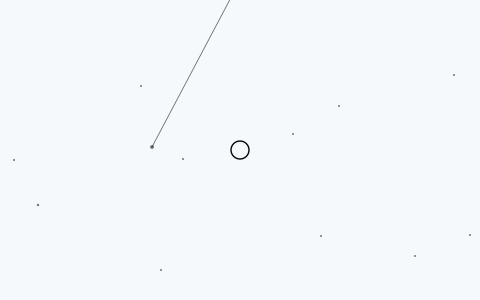
It is near Acubens in Cancer, south of the Beehive. Binoculars show a soft glow; a telescope, a field of faint stars.
Look for
From 50° north it climbs to 52°; from 35° north it climbs to 67°; from the equator it climbs to 78°; from 35° south it climbs to 43°.
Look for
Magnitude 6.9 against the faintest star each can show: the eye under a city sky, 4.5 (2.4 short); the eye under a dark country sky, 7.0 (0.1 to spare); 50 mm binoculars under that dark sky, 11.0 (4.1 to spare); a 100 mm telescope there, 12.5 (5.6 to spare). Through 7×50 binoculars, whose field is about 7.1° across, it spans 6% of the field’s width; through a 100 mm telescope at 50×, a field about 1° across, it spans 42% of the field’s width.