Star Stars · In Leo
Algieba
Algieba, γ¹ Leonis, is an orange giant in Leo: the 52nd brightest star in the night sky.
Save the chart (SVG) Tactile chart (A4 SVG)
- Constellation
- Leo
- Designation
- γ¹ Leonis
- Apparent magnitude
- 2.01 · 52nd brightest star in the night sky
- Spectral class
- K0III
- Distance
- 130 light-years
- Highest at midnight
- late February
- Position (J2000)
- RA 10h 20m · Dec +19° 50′
An orange giant, around 5,200 K, like Arcturus and Aldebaran. About 63× brighter than the faintest star the eye can see. Gives off about 210 times the Sun's visible light. The light you are seeing left around 1896.
When to see it
On the night of Mon 22 Feb 2027, when it is highest around midnight, on each city’s own clock:
| From | Rises | Highest | Sets |
|---|---|---|---|
| London GMT | 16:25 | 00:11 · 58° | 07:57 |
| New York EST | 16:55 | 00:06 · 69° | 07:16 |
| Singapore GMT+8 | 19:15 | 01:16 · 72° | 07:17 |
| Sydney GMT+11 | 20:04 | 01:07 · 36° | 06:11 |
Common questions
- Can I see it from 50° north?
- Yes. It rises and sets, and at its highest it stands 60° up in the south.
- Can I see it from 35° south?
- Yes. It rises and sets, and at its highest it stands 35° up in the north.
- When is the best time of year to see it?
- Around late February, when it stands opposite the Sun and is highest at midnight. It comes round about two hours earlier each month, so by late May it is highest in the early evening, and in late November not until the hours before dawn.
- How far away is it, and how bright?
- It is 130 light-years away, and shines at magnitude 2.01 in our sky. From that far, the Sun would be a star of magnitude 7.8: too faint for the eye, a target for binoculars.
- Naked eye, binoculars or telescope?
- The naked eye, even from a city: at magnitude 2.01 it is brighter than the faintest stars a city sky still shows, about magnitude 4.5.
Look for
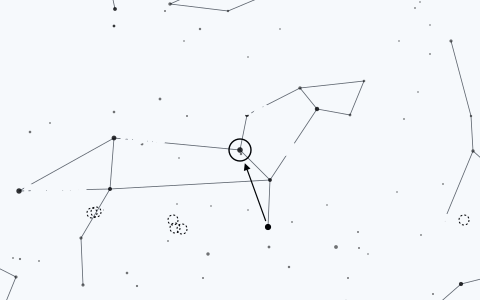
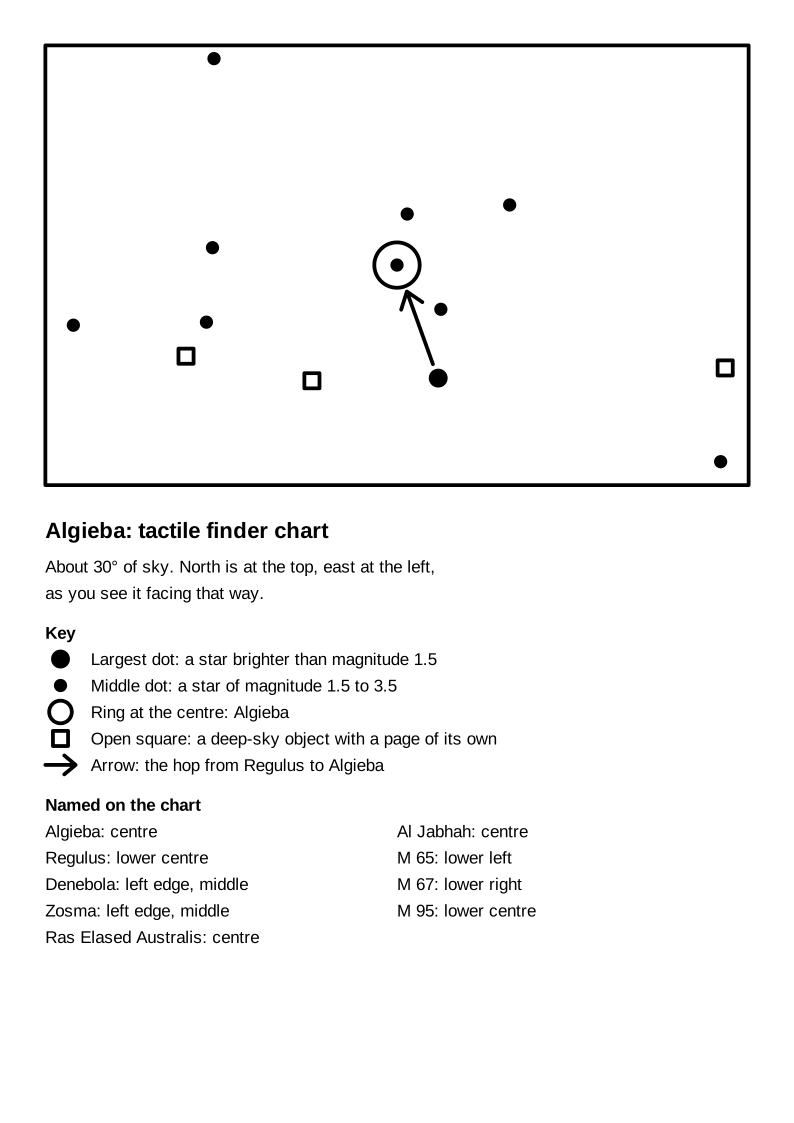
Start from Regulus: Algieba is 8.4° north of it, a fist at arm’s length.
Look for
From 50° north it climbs to 60°; from 35° north it climbs to 75°; from the equator it climbs to 70°; from 35° south it climbs to 35°.
Science
Algieba’s surface is about 5,200 K, some 600 K cooler than the Sun’s 5,772 K, so its light is strongest at about 560 nm, where the Sun’s is strongest at 500 nm. Moved to 33 light-years, the distance astronomers compare stars at, it would shine at magnitude −1.0.
Did you know
Against Regulus, the brighter star the hop starts from: Regulus looks 1.8 times as bright as Algieba in our sky, but Regulus is 79 light-years away and Algieba 130 light-years, so side by side Algieba would give off 1.5 times as much light as Regulus.
Science
Algieba is the 62nd nearest to us of the 156 stars on these pages with a measured distance. Its nearest neighbour among them in space is Regulus, about 53 light-years from it; on our sky the two are 8.4° apart.
Look for
The Sun passes 8.8° south of Algieba around late August, when it is highest at noon, in daylight: the weeks either side are its worst time of year. From 50° north it is above the horizon for about 15 hours a day, from 35° north about 14 and from 35° south about 10. It is 55° from the plane of the Milky Way, well away from the band.