M 18 Deep sky · Open cluster in Sagittarius · M 18 · NGC 6613
Black Swan Cluster
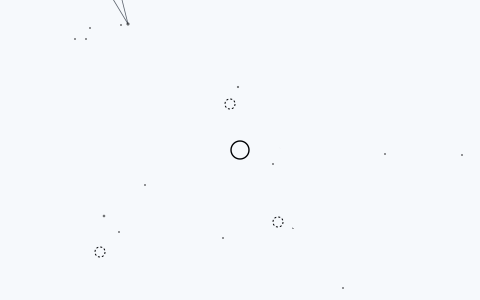
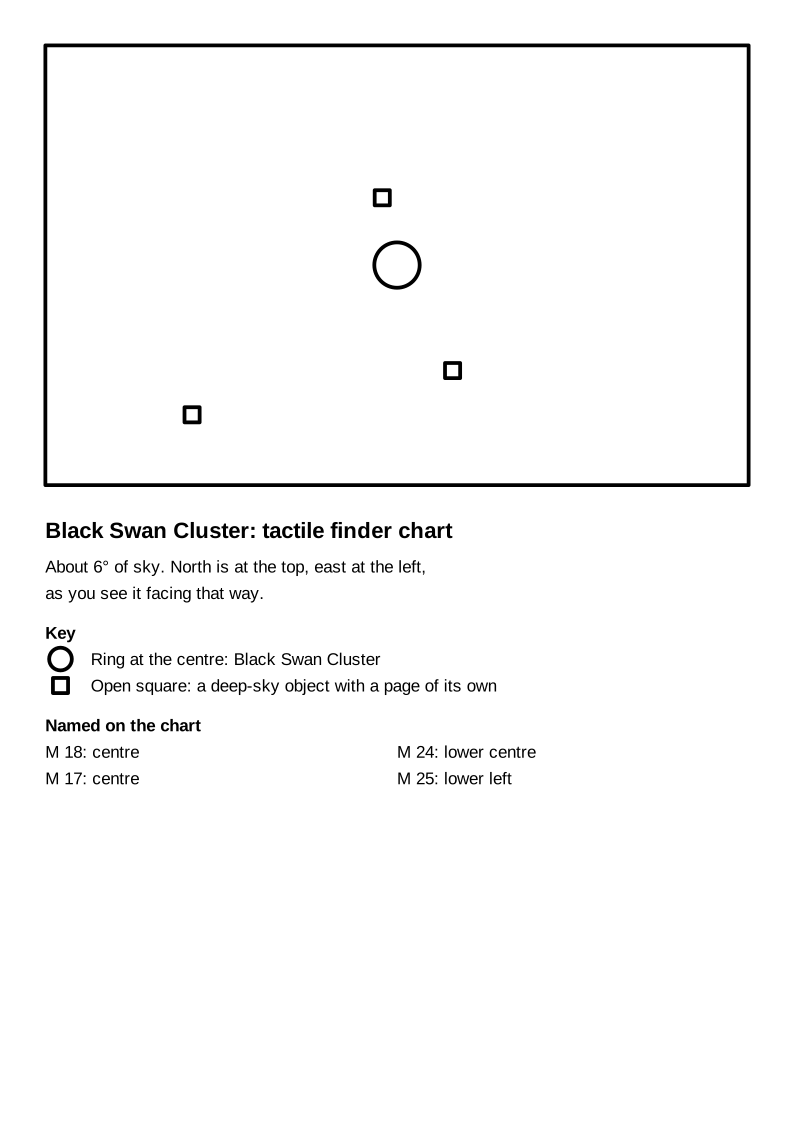
A small, sparse open cluster that is easy to overlook, squeezed between the Omega Nebula and the Small Sagittarius Star Cloud.
Save the chart (SVG) Tactile chart (A4 SVG)
- Type
- Open cluster
- Designations
- M 18 · NGC 6613
- Constellation
- Sagittarius
- Apparent magnitude
- 6.9
- Apparent size
- 7′
- Position (J2000)
- RA 18h 20m · Dec −17° 06′
The full Moon, about 31′ across, is 4.4 times as wide. The Sun passes 6° from it around late December, and for about 27 days of the year it sits within 15° of the Sun, lost in its glare.
When to see it
On the night of Thu 24 Jun 2027, when it is highest around midnight, on each city’s own clock:
| From | Rises | Highest | Sets |
|---|---|---|---|
| London GMT+1 | 20:42 | 01:10 · 21° | 05:38 |
| New York EDT | 20:07 | 01:05 · 32° | 06:02 |
| Singapore GMT+8 | 19:18 | 01:15 · 72° | 07:13 |
| Sydney GMT+10 | 17:20 | 00:06 · 73° | 06:53 |
Common questions
- Can I see it from 50° north?
- Yes. It rises and sets, and at its highest it stands 23° up in the south.
- Can I see it from 35° south?
- Yes. It rises and sets, and at its highest it stands 72° up in the north.
- When is the best time of year to see it?
- Around late June, when it stands opposite the Sun and is highest at midnight. It comes round about two hours earlier each month, so by late September it is highest in the early evening, and in late March not until the hours before dawn.
- Naked eye, binoculars or telescope?
- The naked eye, from a dark country sky, which shows stars to about magnitude 7.0; from a city, binoculars.
Look for
Sweep south from the Omega Nebula towards the star cloud: it is the little knot of stars in between.
Look for
From 50° north it climbs to 23°; from 35° north it climbs to 38°; from the equator it climbs to 73°; from 35° south it climbs to 72°.
Look for
Magnitude 6.9 against the faintest star each can show: the eye under a city sky, 4.5 (2.4 short); the eye under a dark country sky, 7.0 (0.1 to spare); 50 mm binoculars under that dark sky, 11.0 (4.1 to spare); a 100 mm telescope there, 12.5 (5.6 to spare). Through 7×50 binoculars, whose field is about 7.1° across, it spans 2% of the field’s width; through a 100 mm telescope at 50×, a field about 1° across, it spans 12% of the field’s width.
Words used here
Its constellation
Nearby in Sagittarius
- Nebula Lagoon Nebula
- Nebula Trifid Nebula
- Globular cluster Great Sagittarius Cluster
- Nebula Omega Nebula
- Open cluster Webb's Cross
- Open cluster M 23
- Open cluster Small Sagittarius Star Cloud
- Open cluster M 25
- Globular cluster M 28
- Globular cluster M 54
- Globular cluster Specter Cluster
- Globular cluster M 69
- Globular cluster M 70
- Globular cluster M 75