M 47 Deep sky · Open cluster in Puppis · M 47 · NGC 2422
M 47
A bright, loose open cluster in Puppis that was lost for nearly two centuries because Messier wrote down its position wrongly.
Save the chart (SVG) Tactile chart (A4 SVG)
- Type
- Open cluster
- Designations
- M 47 · NGC 2422
- Constellation
- Puppis
- Apparent magnitude
- 4.4
- Apparent size
- 25′
- Position (J2000)
- RA 07h 37m · Dec −14° 29′
It is about as wide as the full Moon, which is about 31′ across. The Sun comes no nearer to it than 36°, around late July, so it is never lost in the Sun’s glare, which reaches about 15° out.
When to see it
On the night of Tue 12 Jan 2027, when it is highest around midnight, on each city’s own clock:
| From | Rises | Highest | Sets |
|---|---|---|---|
| London GMT | 19:26 | 00:09 · 24° | 04:52 |
| New York EST | 18:56 | 00:04 · 35° | 05:11 |
| Singapore GMT+8 | 19:17 | 01:14 · 74° | 07:12 |
| Sydney GMT+11 | 18:26 | 01:05 · 71° | 07:44 |
Common questions
- Can I see it from 50° north?
- Yes. It rises and sets, and at its highest it stands 26° up in the south.
- Can I see it from 35° south?
- Yes. It rises and sets, and at its highest it stands 69° up in the north.
- When is the best time of year to see it?
- Around mid January, when it stands opposite the Sun and is highest at midnight. It comes round about two hours earlier each month, so by mid April it is highest in the early evening, and in mid October not until the hours before dawn.
- Naked eye, binoculars or telescope?
- The naked eye, even from a city: at magnitude 4.4 it is brighter than the faintest stars a city sky still shows, about magnitude 4.5.
Look for
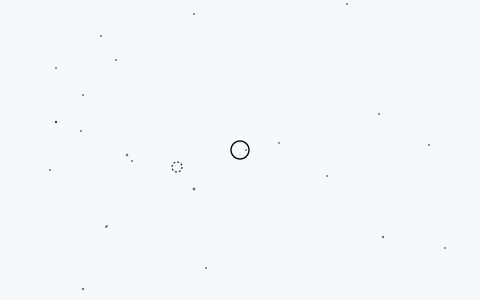
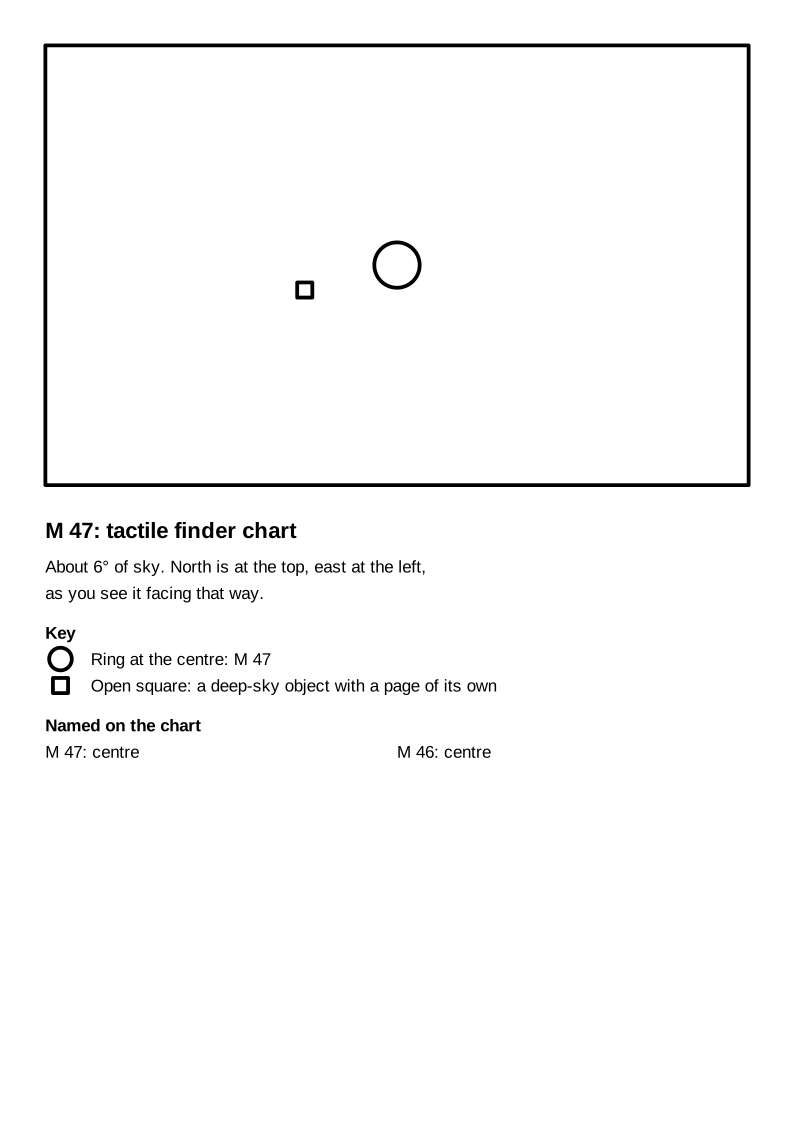
Its few bright stars stand out against the fainter haze of its neighbour M 46, in the same binocular field.
History
Messier made a sign error in his notes, so his position pointed at empty sky. Only in the twentieth century did someone work out that he meant this cluster.
Look for
From 50° north it climbs to 26°; from 35° north it climbs to 41°; from the equator it climbs to 76°; from 35° south it climbs to 69°.
Look for
Magnitude 4.4 against the faintest star each can show: the eye under a city sky, 4.5 (0.1 to spare); the eye under a dark country sky, 7.0 (2.6 to spare); 50 mm binoculars under that dark sky, 11.0 (6.6 to spare); a 100 mm telescope there, 12.5 (8.1 to spare). Through 7×50 binoculars, whose field is about 7.1° across, it spans 6% of the field’s width; through a 100 mm telescope at 50×, a field about 1° across, it spans 42% of the field’s width.