M 9 Deep sky · Globular cluster in Ophiuchus · M 9 · NGC 6333
M 9
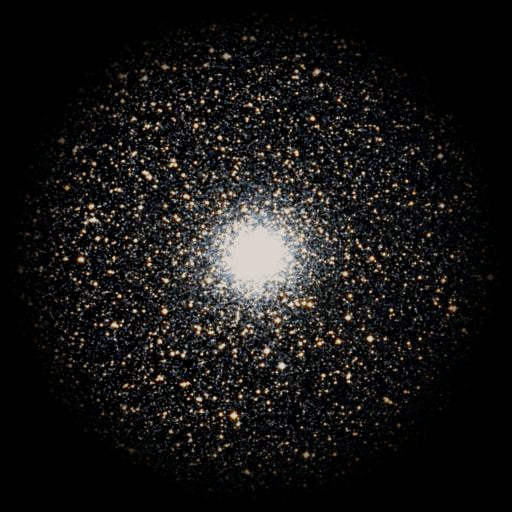
A globular cluster close to the heart of the Milky Way, its light dimmed and reddened by the dust that lies between it and us.
Save the chart (SVG) Tactile chart (A4 SVG)
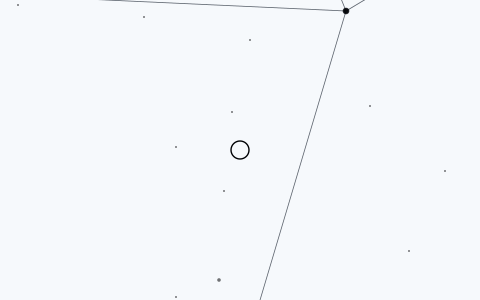
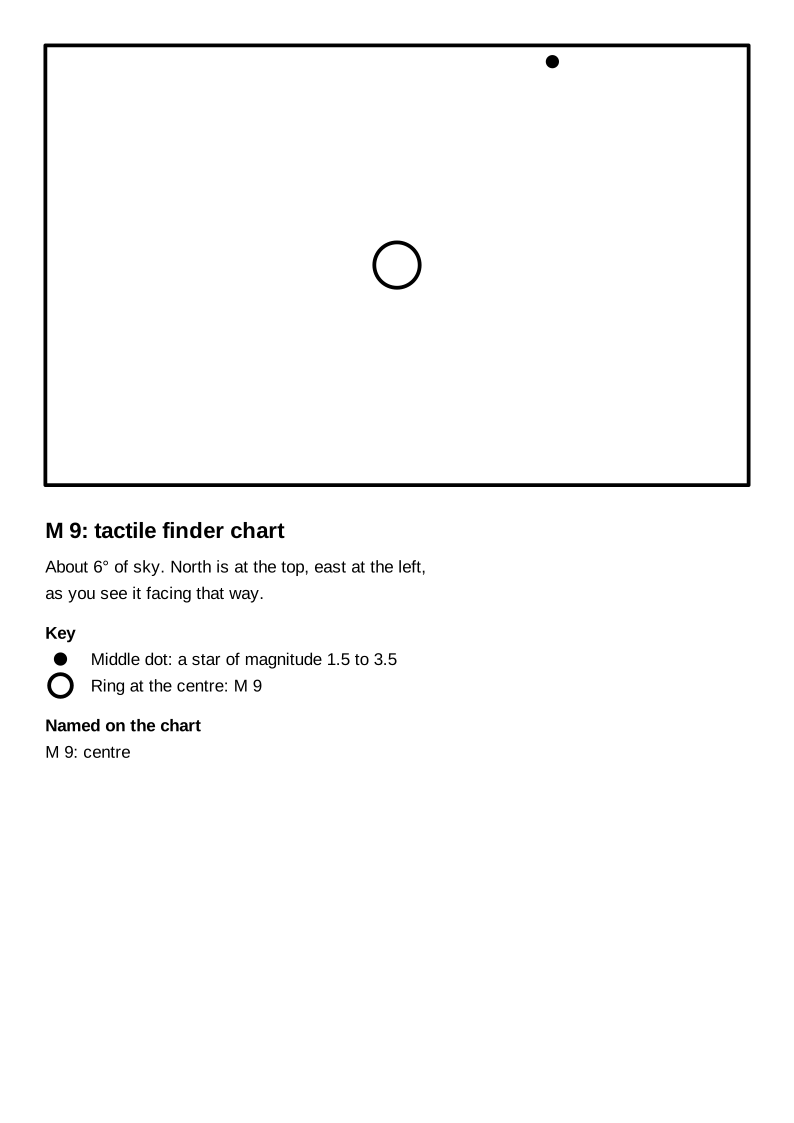
- Type
- Globular cluster
- Designations
- M 9 · NGC 6333
- Constellation
- Ophiuchus
- Apparent magnitude
- 8.4
- Apparent size
- 12′
- Position (J2000)
- RA 17h 19m · Dec −18° 31′
The full Moon, about 31′ across, is 2.6 times as wide. The Sun passes 5° from it around mid December, and for about 28 days of the year it sits within 15° of the Sun, lost in its glare.
When to see it
On the night of Tue 8 Jun 2027, when it is highest around midnight, on each city’s own clock:
| From | Rises | Highest | Sets |
|---|---|---|---|
| London GMT+1 | 20:53 | 01:12 · 20° | 05:32 |
| New York EDT | 20:15 | 01:07 · 31° | 05:59 |
| Singapore GMT+8 | 19:20 | 01:18 · 70° | 07:15 |
| Sydney GMT+10 | 17:18 | 00:09 · 75° | 06:59 |
Common questions
- Can I see it from 50° north?
- Yes. It rises and sets, and at its highest it stands 21° up in the south.
- Can I see it from 35° south?
- Yes. It rises and sets, and at its highest it stands 74° up in the north.
- When is the best time of year to see it?
- Around early June, when it stands opposite the Sun and is highest at midnight. It comes round about two hours earlier each month, so by early September it is highest in the early evening, and in early March not until the hours before dawn.
- How bright is it?
- Magnitude 8.4 in total, but that light is spread over 12′ of sky: on average 22.4 magnitudes per square arcsecond. Against a dark country sky that average stands out; a city’s glow drowns all but its brightest parts.
- Naked eye, binoculars or telescope?
- Binoculars. At magnitude 8.4 it is past the eye, but a 50 mm pair under a dark sky reaches about magnitude 11.0.
Look for
It is small and compact in a telescope. Dark lanes of dust cut across the star fields beside it in Ophiuchus.
Look for
From 50° north it climbs to 21°; from 35° north it climbs to 36°; from the equator it climbs to 71°; from 35° south it climbs to 74°.
Look for
Magnitude 8.4 against the faintest star each can show: the eye under a city sky, 4.5 (3.9 short); the eye under a dark country sky, 7.0 (1.4 short); 50 mm binoculars under that dark sky, 11.0 (2.6 to spare); a 100 mm telescope there, 12.5 (4.1 to spare). Those limits are for a point of light; its light is spread over its whole size, so it needs some of that margin in hand. Through 7×50 binoculars, whose field is about 7.1° across, it spans 3% of the field’s width; through a 100 mm telescope at 50×, a field about 1° across, it spans 20% of the field’s width.